Case Study
Life Science Company: Custom Microfluidic Device
Phase I: Assay Feasibility
A life science company developing a multiplexed assay for maternal health applications approached BurstDX after encountering commercialization challenges with its existing microfluidic device.
The original system relied on a traditional chip-based microfluidic design that was overly complex, expensive to manufacture, and unable to meet the low cost-of-goods (COGS) target required for commercialization. The partner’s goal was to develop a disposable test format capable of achieving a COGS below $2 per test while still maintaining quantitative analytical performance.
In addition to reducing manufacturing cost and complexity, the device also needed to:
Support multiplex detection through a single sample inlet
Enable passive mixing of reagents and targets within the device
Maintain performance in both buffer and serum matrices
The Challenge
Our Role
BurstDX was selected to support assay integration, custom microfluidic design, prototype development, assay optimization, and proof-of-concept validation within a simplified low-cost device architecture.
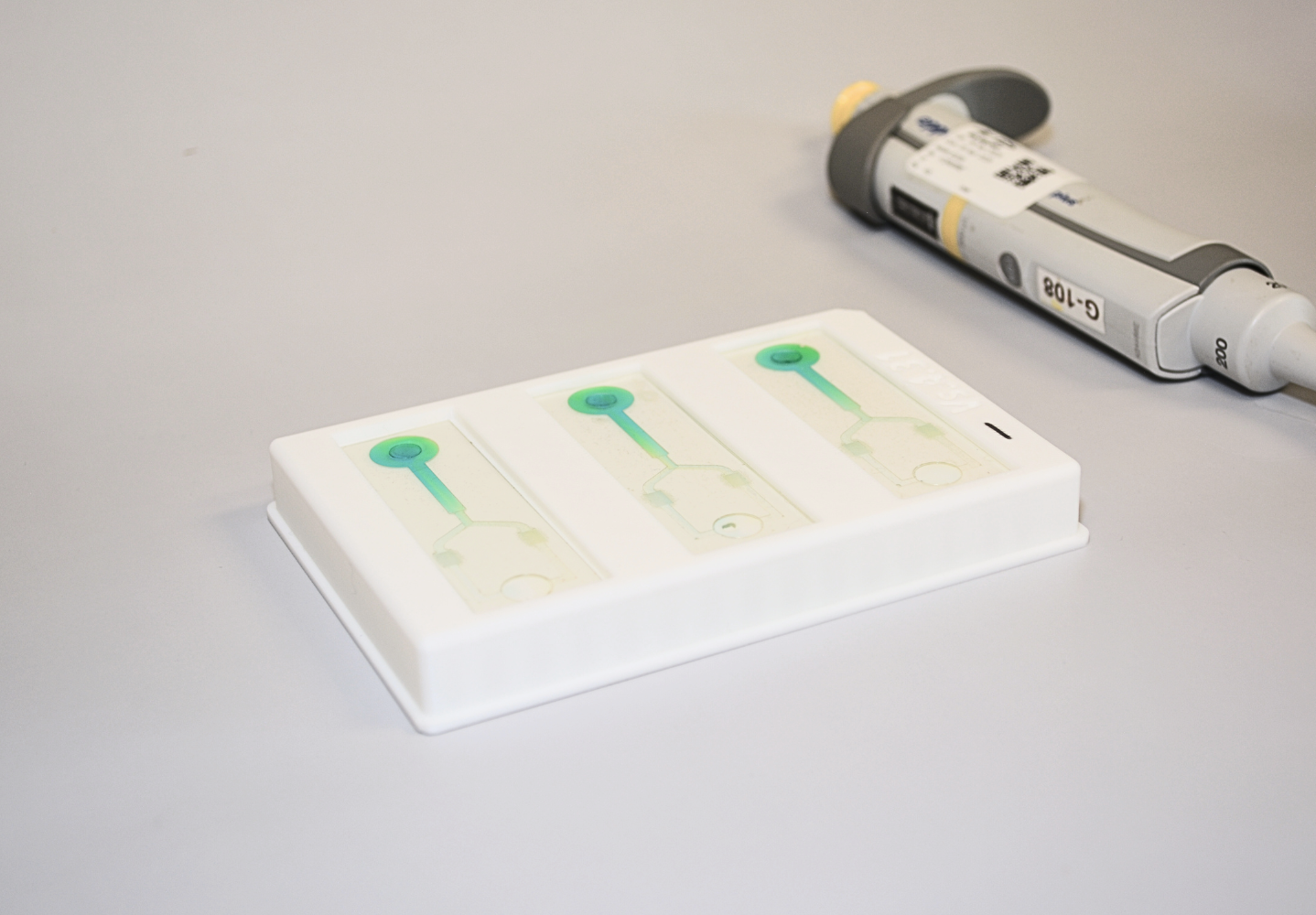
Rather than relying on a traditional rigid microfluidic chip format, BurstDX developed a custom laminate-based microfluidic design intended to significantly reduce device complexity and improve manufacturability potential.
The objective was to create a compact, lower-cost disposable format capable of supporting multiplex detection, dried reagent integration, passive mixing, and quantitative assay performance while aligning with the partner’s sub-$2 COGS target.
Performed initial laboratory testing to establish baseline assay performance.
Designed and assembled multiple generations of custom laminate-based microfluidic prototypes to simplify the device and improve manufacturability.
Optimized reagent release and in-device mixing to improve assay consistency and signal generation.
Developed an updated device design to improve interaction between reagents and targets within the microfluidic device.
Evaluated assay performance in serum samples to assess biological compatibility and matrix effects.
Established a quantitative dose-response curve in both buffer and serum samples to validate final prototype performance.
Designed the system to support multiplex detection, single-inlet sample introduction, compact dimensions, and scalable low-cost manufacturing.
Key Activities
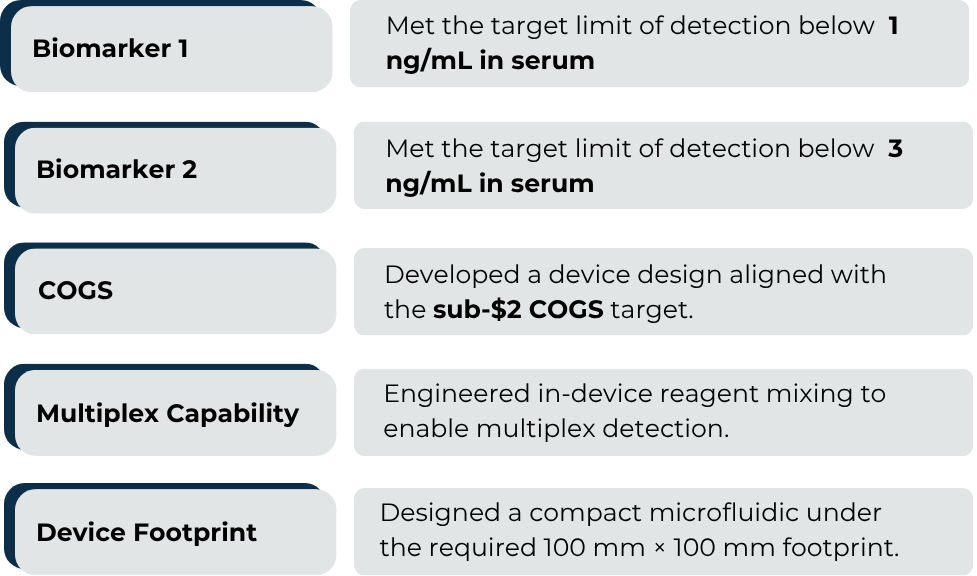
BurstDX successfully helped transition the assay workflow away from an overly complex traditional microfluidic chip architecture toward a simplified laminate prototype with lower manufacturing costs.
The project demonstrated:
Multiplex assay functionality through a single sample inlet
Quantitative dose-response performance in both buffer and serum
Reduced system complexity relative to the original design
A commercially viable path capable of achieving a sub-$2 COGS target
The Impact